I use arraybuild( and arrayselectedbuild( a lot, but there is a strange error here.
According to the help pages for arraybuild( and aggregate(, the ««field»» notation ‘specifies that a field is in the current database, instead of the database that is being scanned/aggregated’. Also a post by Jim in 2019 confirms my interpretation of that sentence:
Therefore if I take this tree of names:
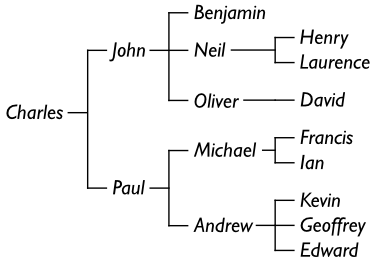
and from it make a database of each Person and his Parent:
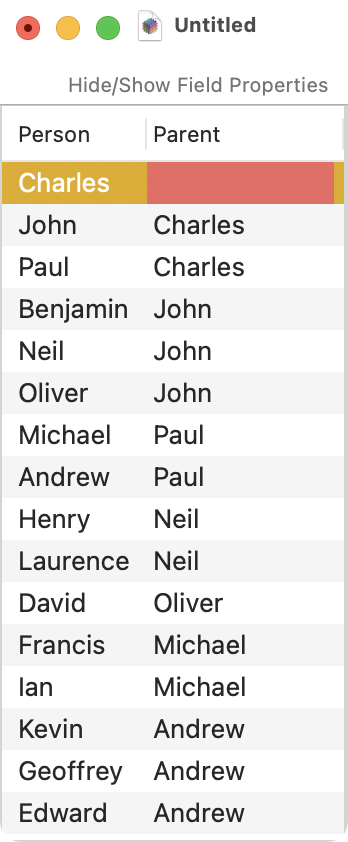
then the Children of each Person would be an array of all the Persons in this database whose Parent is this Person. With a comma and space separating the Children, the formula for them should be:
arraybuild( {, }, {}, {Person}, {Parent=««Person»»} )
However, that results in the error:
fieldvalue( function: data field “Person” does not exist.
The help page for arraybuild( also states:
Internally, Panorama actually converts double chevrons into the fieldvalue( function.
and if I do that conversion myself, modifying the above formula to:
arraybuild( {, }, {}, {Person}, {Parent=fieldvalue("",Person)} )
then I get the result I originally wanted:
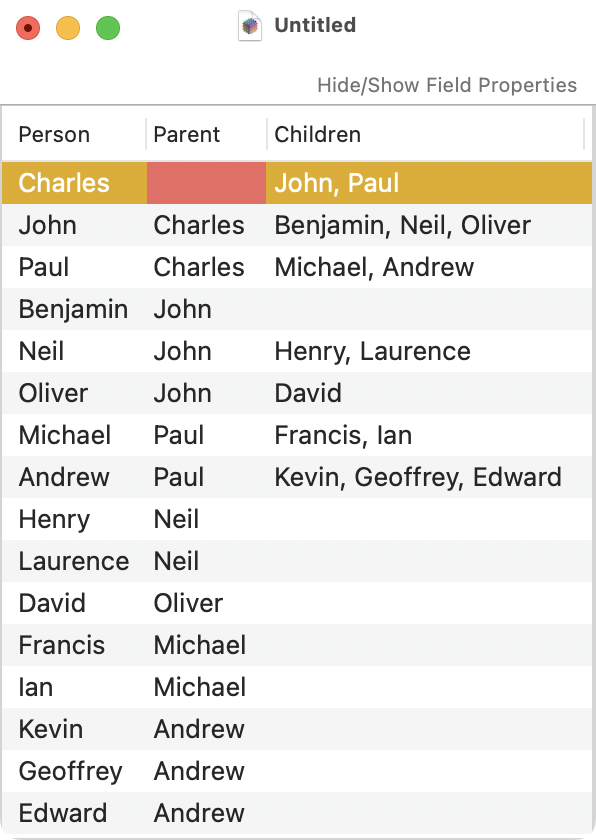
So why does this work using fieldvalue( but not the simpler ««...»» notation? Perhaps ««…»» doesn’t take account of the possibility that the database in question might be the current one, denoted by the empty string.
(I noticed this in a much bigger database containing more complex heirarchical relationships, but this shows the same error more clearly.)